
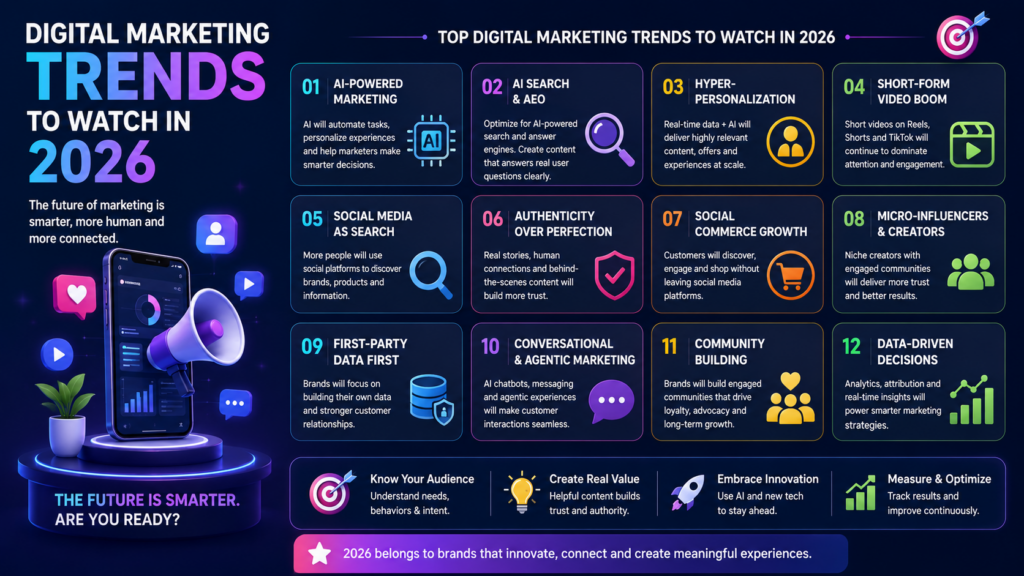
Digital marketing continues to evolve rapidly, and 2026 is shaping up to be an important year for businesses, marketers, and content creators. Artificial intelligence, AI-powered search, personalization, social commerce, short-form video, and community-driven marketing are changing how brands attract and engage customers.
For businesses, keeping up with these digital marketing trends in 2026 is not just about following technology. It is about understanding how customer behavior is changing and adapting marketing strategies accordingly.
Here are some of the most important digital marketing trends to watch in 2026.
1. AI Is Becoming a Core Marketing Tool
Artificial intelligence is moving beyond experimentation and becoming part of everyday marketing workflows.
Marketers are using AI for content creation, personalization, automation, customer analysis, campaign optimization, and idea generation. HubSpot’s 2026 State of Marketing report identifies AI-powered personalized content as the top marketing trend among surveyed marketers. citeturn0search1
AI can help marketers:
- Generate content ideas
- Analyze customer behavior
- Personalize marketing messages
- Automate repetitive tasks
- Improve campaign efficiency
- Create different content variations
- Analyze large amounts of marketing data
However, AI should support human creativity rather than completely replace it. Original ideas, brand personality, experience, and human judgment remain important.
2. AI Search Is Changing SEO
One of the biggest changes in digital marketing is the growth of AI-powered search.
People are increasingly using AI assistants and conversational search tools to ask questions, research products, compare options, and make purchasing decisions.
Google’s 2026 marketing outlook highlights how AI is changing search from simple fact-finding toward more conversational and exploratory experiences. citeturn0search0
This means businesses need to think beyond traditional keyword rankings.
What businesses should focus on:
- Helpful, people-first content
- Clear answers to customer questions
- Strong topical expertise
- Reliable and authoritative information
- Structured, easy-to-understand content
- A strong overall online presence
This has increased interest in Answer Engine Optimization (AEO) and other approaches designed to improve a brand’s visibility in AI-generated answers.
3. Personalization Will Become More Important
Customers increasingly expect brands to provide relevant experiences instead of generic messages.
AI is making it easier for businesses to personalize content at scale. According to HubSpot’s 2026 research, 93.2% of surveyed marketers say personalized or segmented experiences have led to more leads and purchases. citeturn0search1
Personalization can include:
- Customized email campaigns
- Product recommendations
- Personalized website experiences
- Audience-specific content
- Personalized advertisements
- Relevant offers
The goal is simple: show the right message to the right person at the right time.
4. Short Form Video Will Continue to Grow
Short-form video remains one of the most important content formats across social platforms.
Instagram Reels, YouTube Shorts, TikTok, and similar formats allow brands to communicate ideas quickly and reach audiences through engaging visual content.
HubSpot’s 2026 social media research identifies short-form video as the leading format in usage and investment among marketers. citeturn0search7
Businesses can use short-form videos for:
- Educational tips
- Product demonstrations
- Behind-the-scenes content
- Tutorials
- Customer testimonials
- Industry insights
- Brand storytelling
The focus should not simply be on producing more videos. The content should be useful, entertaining, authentic, or emotionally engaging.
5. Social Media Is Becoming a Search Platform
Social media is no longer only a place to connect with friends and followers.
People increasingly use social platforms to discover brands, products, restaurants, services, creators, and information.
HubSpot reports that social discovery is increasingly replacing traditional search for some users, particularly younger audiences. citeturn0search10
This means businesses should optimize their social content for discovery.
Use:
- Clear captions
- Relevant keywords
- Descriptive content
- Useful hashtags where appropriate
- Strong visual content
- Search-friendly profile information
Your Instagram or YouTube content can now act as another form of search visibility.
6. Authenticity Will Matter More Than Perfect Content
AI can make it easier than ever to create polished content. But when everyone can produce highly polished content, authenticity becomes a competitive advantage.
HubSpot’s 2026 social media research found that 77% of surveyed social media marketers believe authenticity is more important than production value. citeturn0search8
Brands can build authenticity by showing:
- Real people
- Behind-the-scenes moments
- Customer experiences
- Genuine opinions
- Company stories
- Unedited or less-polished content
Customers want to know the people and story behind a brand—not just see advertisements.
7. Social Commerce Will Continue to Expand
Social media is increasingly becoming part of the buying journey.
Customers can discover products through social posts, watch demonstrations, interact with creators, and move toward purchasing without leaving the social platform.
HubSpot’s 2026 research found that 69% of marketers expect more shopping to happen through social platforms than brand websites. citeturn0search7
Businesses should consider how social media can support the entire customer journey:
Discovery → Engagement → Consideration → Purchase → Loyalty
This makes social media an important channel not only for awareness but also for conversion.
8. Micro Influencers and Creators Are Becoming More Valuable
Influencer marketing is evolving from simply choosing creators with the largest follower counts.
Brands are increasingly interested in creators who have highly relevant and engaged communities.
Micro- and mid-tier creators can offer:
- Niche audiences
- Stronger community relationships
- Higher relevance
- Authentic communication
- Potentially better campaign efficiency
For a small business, working with a creator who has a highly relevant audience may be more valuable than partnering with a celebrity whose audience has little connection to the product.
9. First Party Data Will Become More Important
As privacy expectations and digital advertising environments continue to change, businesses need to build stronger relationships with their own customers and audiences.
First party data is information collected directly from your audience, such as:
- Email subscribers
- Customer purchases
- Website interactions
- Customer preferences
- Feedback
- Account information
Experian’s 2026 digital trends research highlights first-party data as an important area of investment, particularly among B2B marketers. citeturn0search2
Businesses that responsibly collect and use their own customer data can create more relevant experiences while reducing dependence on external audience data.
10. Conversational and Agentic Marketing Will Grow
Customers increasingly expect brands to respond quickly and naturally.
Marketing is moving from one-way communication toward more interactive experiences involving AI assistants, chatbots, messaging, and automated customer interactions.
Salesforce’s 2026 research reports that customers increasingly expect two-way conversations with brands and that AI is reshaping customer expectations. citeturn0search5
Agentic search is also becoming more relevant to commerce. Salesforce reported that agentic search grew 200% year over year as a starting point for shopping journeys. citeturn0search12
This means businesses should make it easier for customers to:
- Ask questions
- Get instant answers
- Compare products
- Receive recommendations
- Contact businesses through messaging
- Complete actions quickly
11. Community Building Will Become a Competitive Advantage
In an increasingly crowded digital environment, simply collecting followers is not enough.
Strong communities can create deeper relationships between customers and brands.
Businesses can build communities through:
- Social media groups
- Comments and conversations
- Live sessions
- Customer communities
- User-generated content
- Exclusive content
- Events and webinars
The goal is to move from “audience” to “community.”
A community is more likely to interact with your content, recommend your brand, provide feedback, and remain connected over time.
12. Data Driven Marketing Will Become Essential
Marketing decisions should increasingly be based on data rather than assumptions.
Businesses can track:
- Website traffic
- Engagement
- Leads
- Conversion rates
- Customer acquisition costs
- Return on advertising spend
- Email performance
- Social media performance
The important part is not simply collecting data. Marketers need to understand what the data means and use it to improve campaigns.
How Businesses Can Prepare for Digital Marketing in 2026
You don’t need to adopt every new trend immediately.
Instead, focus on the trends that match your business and audience.
Start with these steps:
1. Build a strong digital foundation
Make sure your website, social profiles, content, and branding are consistent.
2. Start using AI responsibly
Use AI to improve efficiency, research, personalization, and ideation while maintaining human oversight.
3. Adapt your SEO strategy
Create helpful content that can satisfy both traditional search and AI powered search experiences.
4. Invest in short form video
Experiment with Reels, Shorts, and other short-form formats.
5. Focus on authenticity
Show the people, personality, and story behind your brand.
6. Understand your audience
Use analytics, customer feedback, and first-party data to understand what your customers actually want.
7. Measure your results
Track meaningful business outcomes instead of focusing only on likes and followers.
Final Thoughts
The biggest digital marketing trends of 2026 are not just about new tools or platforms. They reflect a larger change in how people discover information, interact with brands, and make purchasing decisions.
AI-powered search, personalization, short-form video, social commerce, creator marketing, first-party data, and community building are becoming increasingly important.
But one principle remains constant: understand your audience and provide real value.
Businesses that combine technology with authentic communication, useful content, strong customer experiences, and data-driven decision-making will be better positioned to grow in the evolving digital landscape.
Frequently Asked Questions
What is the biggest digital marketing trend in 2026?
AI is one of the biggest forces shaping digital marketing in 2026, particularly in search, personalization, automation, content creation, and customer engagement.
Is SEO still important in 2026?
Yes. SEO remains important, but businesses increasingly need to optimize content for changing search experiences, including AI-generated answers and conversational search. citeturn0search1turn0search5
Will social media marketing be important in 2026?
Yes. Social media remains a major marketing channel, with Instagram, short-form video, social commerce, creators, and community-building playing important roles. citeturn0search7
How can small businesses use AI in digital marketing?
Small businesses can use AI for content ideas, research, customer personalization, analytics, automation, and campaign optimization while keeping human review and brand voice at the center.
What should businesses focus on most in 2026?
Businesses should focus on understanding their audience, creating valuable content, adapting to AI-powered search, building authentic social presence, using data responsibly, and continuously measuring marketing performance.